

From a Datsun in South Melbourne to the Europa League — the most important coaching story in Australian football history.
We started Strip Tees in 2018. By then the NSL was long gone, the A-League was well into its second decade, and Ange Postecoglou had already won two A-League titles with Brisbane Roar, taken the Socceroos to a World Cup, and was about to quietly revolutionise football in Japan. We came in mid-story. But we came in as football fans who'd been following this game our whole lives — who knew about Roarcelona, who'd watched the 2015 Asian Cup final at a pub with people crying, who understood what Johnny Warren had fought for, who got why the NSL mattered even after it was gone. We weren't late to Ange. We just needed a few years to get the printer sorted.
And none of it — none of it — prepared us for what Ange Postecoglou became.
This is our love letter. It's going to go on a while. Football fandom is not a rational activity. The team doesn't reward your loyalty. The game doesn't owe you anything. And yet you're in. Completely in. It becomes part of how you understand yourself. That's what happened with Ange, for a generation of Australian football fans who had been waiting a very long time to feel it.
Part OneThe NSL, and Why It Matters That You Understand It
Here's the thing about the National Soccer League that most Australian sports fans either don't know or have conveniently forgotten: it was brilliant. Not polished, not well-marketed, not given a fair shake by a sporting media that was fundamentally disinterested in anything that didn't involve an oval ball. But genuinely, stubbornly, passionately brilliant.
The NSL was ethnic Australia's competition. South Melbourne Hellas. Sydney Croatia. Juventus FC (the Adelaide one — keep up). Marconi Stallions. Heidelberg United. APIA Leichhardt. Brunswick Juventus. Green Gully. These were clubs built by immigrant communities — Greek, Croatian, Italian, Portuguese — who'd arrived in Australia and needed, as people always do, a place to belong. A reason to gather. If you were Greek in Melbourne in 1975, South Melbourne Hellas wasn't just a football club. It was your social world, your community centre, the place where the language still sounded like home. Johnny Warren — who played and fought for this game his entire life and didn't live to see everything it became — understood all of that. Les Murray, who arrived in Australia as a Hungarian refugee and became the greatest voice this game has ever had, understood all of that from the inside. When those two talked about Australian football, they were talking about something that mattered to people in ways that the AFL and NRL could never quite touch.
Into this world, at age nine, came Angelos Postecoglou. Born in Nea Filadelfeia, Athens, arrived at Station Pier, Port Melbourne in 1970. His father Dimitris — Jim, to his mates — had been a businessman in Athens until the 1967 military coup made their life untenable. They settled in Prahran: working-class, migrant, proud. Jim told his son two things about football. Keep the ball down. And: there is joy in this game. Not a tactical system. Not a pressing trigger or a defensive shape. Joy. Go on, spend thirty seconds thinking about every Ange team that's ever taken a pitch and try to argue those two instructions aren't still in there somewhere.
"Football to him was all about the joy of the game. It was about scoring goals and loving football."
— Ange Postecoglou on Ferenc Puskás, ESPN
Young Ange joined South Melbourne Hellas as a nine-year-old, worked through the youth ranks, and became a first-team left-back. He was good — good enough to be named in South Melbourne's team of the century, good enough to wear the Socceroos shirt. He played 193 NSL games for the club between 1984 and 1993, won two titles, and captained the side to the 1990-91 championship in a penalty shootout win over Melbourne Croatia. Not a bad playing career by any measure.
But the playing career is the prologue. The real story starts in 1989, when something happened at Middle Park that nobody could quite believe.
Part TwoThe Most Incongruous Thing That Ever Happened in Australian Football

In 1989, Ferenc Puskás arrived in Melbourne to manage South Melbourne Hellas.
Read that again. Ferenc Puskás — FIFA Team of the Century, 84 goals in 85 internationals for Hungary, the man who scored four times in what many still regard as the greatest club match ever played (Real Madrid 7 Eintracht Frankfurt 3 in the 1960 European Cup final at Hampden Park) — turned up at Middle Park to manage a club in Australia's ethnic football competition. As the documentary filmmaker Tony Wilson, who has spent years bringing this story to screen, put it: it would be the equivalent of Pelé turning up to coach Central Coast Mariners. No disrespect to the Mariners.
How? Through the Greek-Australian community network. Puskás spoke Greek — he'd managed Panathinaikos and AEK Athens in exile after fleeing Hungary following the 1956 uprising. Through those connections, South Melbourne Hellas landed the most astonishing coaching appointment in the history of Australian football. And almost nobody outside the NSL's loyal following noticed.
Puskás didn't drive. So his captain, Ange Postecoglou, picked him up every morning in a Datsun 200B and drove him to training. We're going to sit with that image. One of the ten best footballers who ever lived — a man who'd shared a dressing room with Di Stéfano, who had demolished England 6-3 at Wembley in the Match of the Century — riding shotgun through South Melbourne in a beat-up Japanese sedan, because his captain was the only one on the squad who could translate between English and Greek.
"I was on the other side of the world and had these ridiculous touch points in my life and career that you couldn't dream of as being stepping stones to where you want to get to."
— Ange Postecoglou, Tottenham Hotspur Official, 2024
For three years Puskás managed South Melbourne with what one observer charitably called a "carefree" 4-3-3 — though "liberating" is probably fairer. He wanted his full-backs to attack. He wanted wingers. He wanted goals. He wanted the crowd to go home happy. Under him, South won the 1990-91 NSL Championship and a stack of cup competitions, and the attendances climbed steadily as word got around that something genuine was happening at Middle Park. Gate figures went from around 4,200 in his first season to over 5,500 by his last.
What Ange absorbed in that Datsun — in those sessions, in those conversations, in the act of translating a footballing genius to his teammates — wasn't a system. Puskás wasn't a clipboard coach. What he transmitted was an attitude. Attacking football isn't a luxury you earn after you've sorted out your defensive structure. It's the starting point. It's the non-negotiable. It's the joy, Jim.
Part ThreeThe Coach Emerges
A knee injury finished Ange's playing career at 30. He'd already started coaching at Western Suburbs in 1994 while still technically a player. In 1996 he returned to South Melbourne in the dugout and did what he always does: won things. Two NSL titles. The Oceania Club Championship. The philosophy, now fully internalised, had its first full expression as a coaching method.
Then came the Socceroos youth teams — three OFC Under-17 Championships, three OFC Under-20 Championships — before a controversial exit in 2007. A brief spell at Panachaiki in Greece. Then, improbably, Whittlesea Zebras. Then Brisbane Roar came calling in 2009.
Now. We need to talk about Roarcelona. Because this is where, for us — a bunch of people who sell football shirts and have been fighting football's corner in this country for years — it became something larger than a good story.

Brisbane Roar had been, in the polite words of the football community, ordinary. Ange arrived mid-crisis in 2009, finished his first season near the bottom, cleared out the established players — Craig Moore, Danny Tiatto, Charlie Miller — brought in his own people, and refused to change how he wanted to play. By 2010-11, with Thomas Broich pulling strings in midfield, Ivan Franjic overlapping at right back, and Henrique and Kosta Barbarouses causing chaos up front, they were premiers and champions.
The 2011 Grand Final at Suncorp Stadium was, frankly, one of the greatest things to ever happen in Australian football. 50,168 people. Two-nil down to Central Coast Mariners in extra time. Henrique pulled one back in the 117th minute. Erik Paartalu equalised from a corner in the 120th. Penalties. Goalkeeper Michael Theoklitos, who had already made a string of saves, stopped two. Brisbane won 4-2. Ange said afterwards: "We've had an absolutely extraordinary season, so I should have expected an extraordinary finish." That is such a him thing to say.
The following season they won it again. Back-to-back championships. A record 36-game unbeaten run through two A-League seasons that still stands today. Football so good and so watchable that it got nicknamed Roarcelona after the Barcelona side that was simultaneously mesmerising the rest of the planet. And on the day of the 2012 title parade, Ange left. Resigned. Gone to Melbourne Victory. That's also very him.
Part Four"The Orange Order Is Restored"
We named a tee after the Simon Hill call. If you were watching on the evening of 22 April 2012 when Besart Berisha headed in a late winner to clinch the Grand Final against Perth Glory, you heard those words come down the broadcast line and you felt them in your chest. The orange order is restored.
"The orange order is restored."
— Simon Hill, Fox Sports, 22 April 2012

That line only lands if you've been there. If you've followed this competition through the lean years — the games at Bluetongue or Canberra Stadium with a thousand people and half of them there to boo — through the seasons when you'd mention the A-League at a barbecue and someone would make a comment about the A-League being for wogs or whatever they said. The reason we — a company that has been fighting for football's corner in this country, shirt by shirt, since before Fox Sports decided it was commercially viable — feel so strongly about Ange isn't the trophies in isolation. It's what the trophies meant. The validation. The proof that you hadn't been wasting your heart on a competition the mainstream decided didn't count.
Roarcelona mattered. The Socceroos at the 2014 World Cup mattered — Cahill's volley against the Netherlands, the goal that made every neutral in the world briefly look up and think, wait, Australia? The 2015 Asian Cup mattered enormously. Massimo Luongo's goal against South Korea in the semi-final. James Troisi's winner in extra time in the final. 76,385 people at Stadium Australia. Australia's first international football trophy. The Western Sydney Wanderers winning the AFC Champions League later that same year and the entire country barely noticing. We noticed. We made a tee. All of it ran through the same idea Ange had been carrying since Prahran: attack, be brave, trust the method, and the joy will follow.
After the Socceroos, Ange went to Yokohama F. Marinos in Japan and applied his system in a completely different football culture — one that historically prizes tactical discipline and defensive caution — and won the J1 League title in 2019, the club's first in 15 years. Then Celtic, where he won two Scottish Premierships, two League Cups and a Scottish Cup, playing football that made 60,000 people at Parkhead feel like they were watching something they'd been waiting for their whole lives.
Then Tottenham Hotspur, where in 2025 he won the UEFA Europa League. First European trophy for Spurs since 1984. The full-back from Prahran, who used to drive the Galloping Major to training in a Datsun, won in Europe.
Part FiveWhat Ange-Ball Actually Is, and Why It Started Here
South Melbourne Hellas — Player
193 NSL games. Two titles. Captained the 1991 championship side. Coached by Puskás. Named in the club's team of the century.
South Melbourne Hellas — Coach
Two NSL titles. Oceania Club Championship. The Puskás philosophy becomes the Postecoglou philosophy.
Brisbane Roar — "Roarcelona"
Back-to-back A-League championships. A-League record 36-game unbeaten run. Suncorp sold out. The orange order is restored.
Socceroos
2014 FIFA World Cup. 2015 AFC Asian Cup — Australia's first international trophy. 2018 World Cup qualification.
Yokohama F. Marinos
J1 League title, 2019. Ange-ball conquers Japan. The rest of the world starts paying attention.
Celtic FC, Glasgow
Two Scottish Premierships. Two League Cups. One Scottish Cup. 60,000 singing his name. Big Ange. Born to coach.
Tottenham Hotspur
UEFA Europa League, 2025. First European trophy for Spurs since 1984. The kid from Prahran wins in Europe.

Let's be precise about Ange-ball, because it deserves precision. It isn't a hashtag or a marketing phrase. It's a coherent and consistent philosophy applied — without meaningful variation — from South Melbourne in the NSL through Brisbane Roar through the Socceroos through Yokohama through Celtic through Spurs. No other Australian coach in the history of the game has applied the same attacking method across that range of contexts and kept winning. That is genuinely extraordinary.
High defensive line. Press high. Full-backs inverted into midfield pockets. Wingers holding width. Relentless forward momentum. And an absolute, principled refusal to abandon the approach when it gets difficult. When journalists press him — and they press him constantly — about playing conservatively to protect a lead, Ange tends to look at them like they've said something mildly offensive. This is not stubbornness for its own sake. It's the belief — held since Jim Postecoglou told his son about joy, held since a young captain drove the Galloping Major to training through the streets of South Melbourne — that attacking football isn't a luxury. It's the point.
"Every team I've managed has played the same way. Every single one, at every level, in every country. I'm not going to change now."
— Ange Postecoglou, approximately every press conference, 2009–2025
The Puskás influence is real and traceable. Puskás played a 4-3-3 at South Melbourne with attacking full-backs and aggressive wingers. Ange kept the attacking instinct but evolved the execution — his full-backs invert into central pockets rather than staying wide, a genuine tactical development rather than simple inheritance. But the spirit is unbroken. The pitch should be big. The game should be open. The crowd should go home having seen something worth talking about.
In Australian football terms, this has always meant something specific. For years the dominant anxiety in our game was respectability — don't embarrass us, qualify and survive, manage the occasion. Ange never played that game. Not at South Melbourne, not at Brisbane Roar — where they played opponents off the park in a competition that had never seen football quite like it — not with the Socceroos in Brazil, going at Spain and Chile rather than sitting deep and hoping, not at Yokohama, not at Celtic, not at Spurs. The message was always the same: we play our way. Every time.
PostscriptFrom Us, at Strip Tees, to Everyone Who Was There All Along
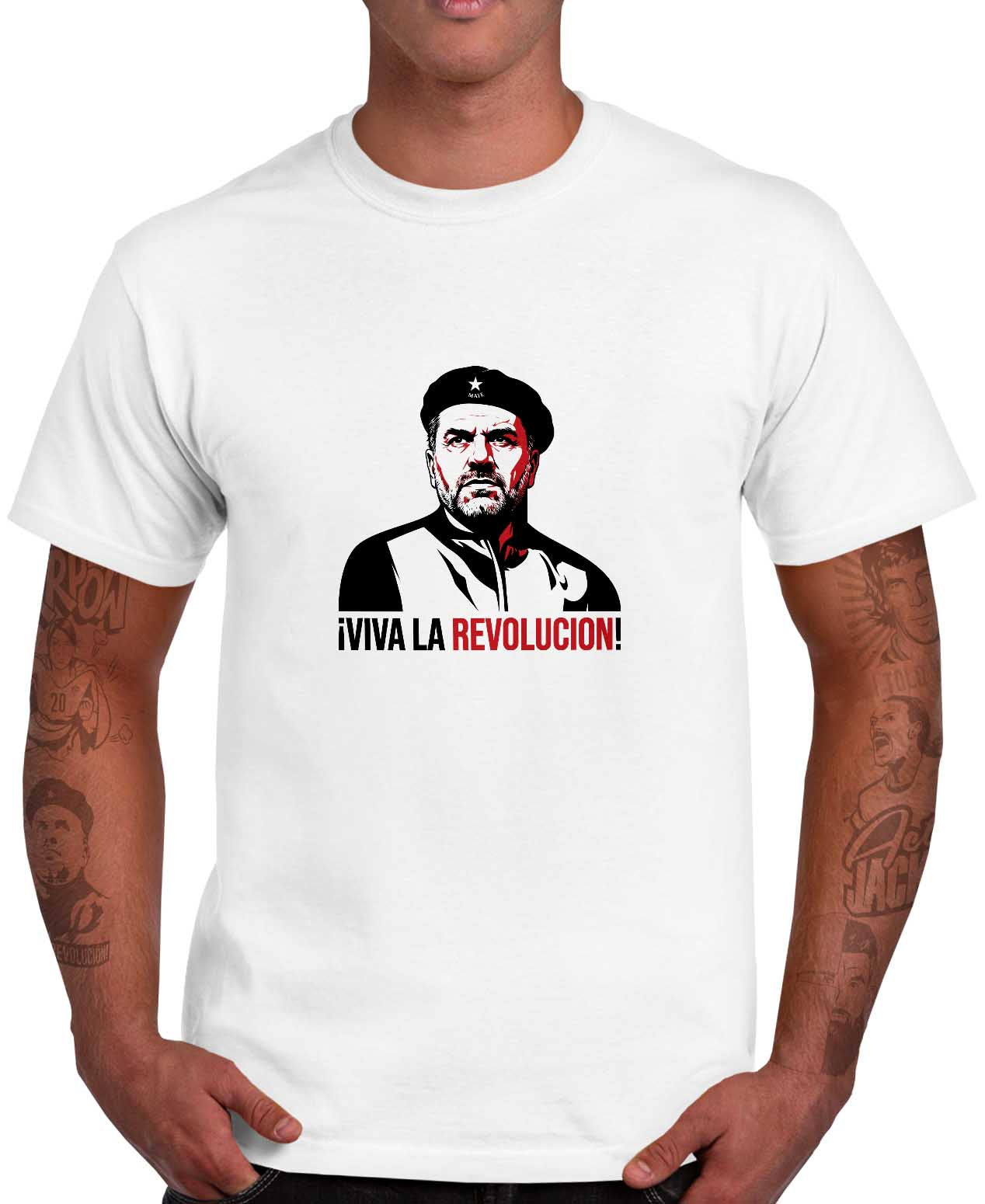
We have a tee that says Viva La Postecoglou Revolución. We've had it for years. We'll have it forever, we reckon. Because what Ange represents isn't just a coaching career or a trophy cabinet — it's a whole argument about what football is for, and that argument started here, in this country, in a competition most of Australia ignored.
We're a small Australian company. We sell football shirts. We started in 2018 because we were football fans who looked around and couldn't find shirts that reflected how we actually felt about the game. We care about it more than is strictly rational, more than our accountant thinks is wise, more than most people in this country — the ones who give you a look when you say football instead of footy — have ever thought was warranted. We've been screaming about the Matildas since before the 2023 World Cup made it briefly fashionable. We made tees for the Wanderers' AFC Champions League win. We've made tees for the Socceroos and the A-League and the NSL's legacy and every corner of this game that deserves celebrating. We know what it means to love something the room hasn't caught up to yet.
Ange Postecoglou is the product of Australian football's community roots — the NSL, the Hellas and Croat and Italian clubs, the migrant communities who built this game here when nobody else cared. He was shaped by a left-field genius arriving at Middle Park with a philosophy forged across Budapest, Real Madrid, Panathinaikos, and somehow, beautifully, the inner south of Melbourne. He was tested in a competition the sporting mainstream never looked at. And then he went out into the world and proved, repeatedly and without apology, that what he'd learned in that so-called backwater was as good as anything the global game had to offer.
We reckoned so all along. We've got the tees to prove it.
Wear the Revolution
The full Ange Postecoglou collection — designed and printed on demand in Australia by Strip Tees.
Sources & Further Reading
Ange Postecoglou career — Wikipedia: Ange Postecoglou
Puskás at South Melbourne — ESPN: Why does Puskás have a statue in Melbourne?
Ange on Puskás — Tottenham Hotspur Official Site
Puskás + South Melbourne history — FTBL Australia
Roarcelona era — Brisbane Roar Official: 2011 Grand Final
Puskás documentary — Documentary Australia: Ange and The Boss
"The Orange Order is Restored" — Simon Hill, Fox Sports, 22 April 2012
All Ange tees — striptees.com.au/collections/ange-postecoglou
0 comments