

It is October 6, 1979. A teenage girl is walking the streets of the Sutherland Shire, posting homemade flyers through letterboxes. She is 18 years old. She is the captain of Australia. About 50 people will show up.
Her name is Julie Dolan. And this, right here, is where our story begins.
Not in 2023. Not with the TV ratings records and the sold-out stadiums and the jerseys selling thirteen times faster than they ever had before. Not with an eight-year-old girl named Maya posting on the internet that she'd started kicking a ball before school because Sam Kerr had inspired her. All of that is real, and all of it matters enormously, and we'll get to it. But the story of the Matildas doesn't start with a roaring crowd. It starts with a young woman walking the streets alone, hoping someone might come and watch.
At Strip Tees, we make shirts because we want to make the invisible game visible — and hopefully shine a light on some of the culture and history around football, especially those who built it before anyone was paying attention. So before we talk about 2023, we want to talk about the women who made 2023 possible.
The First Matildas, Or: Before Anyone Was Watching
Four years before Julie Dolan posted those flyers, an even earlier group of women had already pulled on the green and gold. In 1975, a squad assembled largely from St George Budapest and Ingleburn travelled to Hong Kong to compete in the Asian Women's Championship. They were captained by Pat O'Connor, whose husband Joe was the coach, and they played international football for their country in an era when virtually nobody — not the press, not the public, not the football establishment — thought this was a particularly important thing.
It took until 2023 — the year of the World Cup itself — for Football Australia to formally recognise this squad as the First Matildas. Among them was Aunty Tarita Yvonne Peters, the first Indigenous Matilda, whose presence in that 1975 squad has only recently received the acknowledgement it deserved. These women competed in green and gold, bore the Australian Coat of Arms on their jerseys, finished third in Asia — and for decades, almost nobody knew.

This is the thing about women's sport that gets under your skin if you pay attention: not the injustice of it alone, though that is real, but the sheer, stubborn, remarkable persistence of the women who kept showing up anyway. Pat O'Connor didn't just captain that 1975 team; she also campaigned, alongside Dr Oscar Mate of Perth, to establish the first National Women's Soccer Championships in 1974. She was elected Secretary of the newly-formed Australian Women's Soccer Association at its founding meeting. She built the scaffolding — metaphorically, and at Seymour Shaw Park in 1979, almost literally — on which everything else was constructed.
Back to Julie Dolan. She started playing football at 13, begging to join in with her four brothers. She made her first representative appearance in that 1975 Asian Cup squad at 14, and became Australia's inaugural official captain at 18. Over a 14-year international career she played 34 times for her country. In 1988, she captained the side to a 1-0 victory over Brazil at the pilot Women's World Cup in China — her mother had sewn the Australian badge onto her kit. Four rows of scaffolding planks served as stadium seating. Media interest, as she has recalled many times, was almost non-existent.
And yet. The Julie Dolan Medal, named in her honour in 1988, is still awarded annually to Australia's best female footballer. The sport's premier awards night is called the Dolan Warren Awards. She holds Matildas Cap Number One. She was named IFFHS Oceania Player of the Century. The game she helped build from almost nothing now fills 75,000-seat stadiums.
"Without history you are pretty much nothing," Dolan has said. "It's important that history is recognised and known."
We agree entirely. Which is why we're starting here, with her, and with Pat O'Connor, and with Aunty Tarita Yvonne Peters, before we get to the part the whole country saw on television.
High Fidelity, Or: What Australia Actually Cares About Now
Here's the thing about Australian sports culture that nobody talks about honestly: it has always been slightly anxious. We are great at sport, and we know it, but we've always been worried that the world doesn't fully respect us. We compensate by caring enormously about rugby league and AFL — codes the rest of the planet has, with the greatest of respect, largely ignored. There's safety in a sport nobody else wants. You can't lose on the world stage if you're not on the world stage.
Football is different. Football is the world's sport. Which means that when the Matildas ran out at Stadium Australia in front of 75,784 people for their opening match against Ireland in 2023, the crowd wasn't just football fans. It was people who had never watched a football match in their lives but felt, dimly, that something significant was happening. People who had no idea that Julie Dolan had once printed flyers by hand to get fifty people through the gates.

That number should stop you in your tracks. That's not a sports audience. That's a cultural moment. Like the moon landing, like the Sydney Olympics, like — and I say this without irony — Cathy Freeman at Stadium Australia in 2000. Which brings us to the most astonishing statistic of all.

The semi-final against England shattered the record for the most-watched TV event in Australia since the measurement system was established — eclipsing even Cathy Freeman's iconic 400-metre run at the Sydney Olympics. Think about that for a moment. Freeman's race is one of those moments that exists at the intersection of sport, race, identity and national mythology. The fact that the Matildas broke that record — not just nudged it, but absolutely shattered it — tells you something extraordinary about what had happened to the Australian psyche over those three extraordinary weeks.

About a Girl (Or Rather, About Many of Them)
Let me tell you about Sam Kerr. Not the stat-sheet version — though the stats are staggering; 53 goals in 63 WSL games for Chelsea, 17 goals in 13 games during a single season at Perth Glory — but the human version. The version that matters for what we're talking about here.
Kerr grew up converting from Aussie Rules because, once she was old enough, she was no longer allowed to play with boys. That biographical detail alone should make your blood boil and your heart break simultaneously. The best footballer Australia had ever produced — arguably one of the best players of her generation on the entire planet — was effectively pushed into football by discrimination. And yet. From that exclusion came something that ended up changing the game entirely.

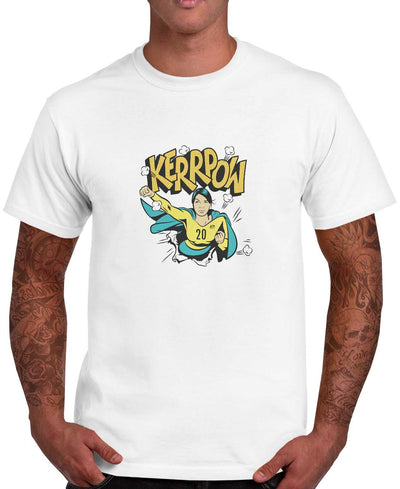
Who Run The World: Kerr!
Because the answer was obvious. Our Sam Kerr tribute tee — celebrating the somersault, the goal, the woman who made an entire country believe. 100% cotton, printed on demand in Australia.
Shop Sam Kerr Tees →
Kerr came into the 2023 World Cup barely fit — an ankle injury had kept her largely on the bench for the group stage and the Round of 16. And then, in the quarter-final against France, she came on as a substitute. And then Australia won on penalties. And then came the semi-final against England. At sixty minutes, with scores level, Katrina Gorry won the ball and found Kerr just inside her own half. What followed — controlling the ball, turning, running, and volleying it into the net — was the kind of moment that makes rational people incapable of speech. Even Didier Drogba, whose own goal it was compared to, posted from his account: "Yours was harder than mine."
Australia lost that semi-final 3-1. Kerr sat on the pitch afterwards, head in her hands, alone in the middle of Stadium Australia. The image went around the world. And yet the message she posted — "We gave it all" with a trail of green and gold hearts — became a kind of rallying cry. Not a concession of defeat. Something more complicated and more honest than that.
Songbook: The Players Who Made Us Feel It
It wasn't just Kerr. One of the genuinely underappreciated things about this Matildas squad was the collective nature of its appeal. When your captain can't play for long stretches, you find out very quickly whether you have depth — and Australia had depth.
Mary Fowler, all nineteen years of her, playing with the kind of loose-limbed confidence that teenagers are only supposed to have when they don't yet understand the stakes. Hayley Raso, scoring that penalty against France with the composure of someone who has already lived the moment ten thousand times in training. Katrina Gorry, whose midfield engine never seemed to stop — who urged the fans after the semi-final: "Don't jump off the bandwagon now, keep on coming." Mackenzie Arnold, keeping goal with saves that made you feel personally grateful. And Gorry's daughter Harper, carried around the pitch in the aftermath of victories, perhaps the youngest fan in attendance.

What these players represented — collectively, as a group — was something Australian sport had rarely offered women: genuine, sustained, unapologetic excellence. Backed by the promise of equal pay (secured in 2019, when Socceroos players accepted a pay cut to equalise salaries), they stood for something beyond football.


Sandra Brentnall: Matilda's First Goal Scorer
She scored Australia's first ever goal at a FIFA Women's World Cup. Now she's on a mug. Because some firsts deserve to be on your breakfast table every morning. Printed on demand in Australia.
Shop the Sandra Brentnall Mug →
Long Way Down, Or: What Happens Next
There is a particular kind of sports fan — and I have been this person, you have probably been this person — who cares desperately about something that the mainstream ignores, and who oscillates between a righteous sense of grievance and an irritable suspicion that the mainstream was probably right to ignore it. Australian football fans have lived in this space for decades. We watched the Socceroos qualify for the 2006 World Cup and felt vindicated, then watched the Matildas do what they did in 2023 and felt something different: not vindication, exactly, but transformation.
Johnny Warren's famous "I Told You So" was always meant to be delivered to football's doubters. What the Matildas said, in August 2023, was addressed to a different audience: to young girls who had been told the sport wasn't for them, to women who'd never seen themselves on the back pages, to a country that had unconsciously decided that its female athletes were supplementary. They said: we are not supplementary. We are the main event.
And Australia — messily, tearfully, with fourteen million people watching and jerseys selling thirteen times faster than ever before — agreed.

The Federal Government pledged $200 million for grassroots women's sport. Women's and girls' participation in football spiked across every state. Coverage of women's sport in Victorian media more than doubled during the tournament. The AFL announced equal prize money for men's and women's competitions. The ripples spread outward in every direction.

There will be a generation of eight-year-olds — like Maya, who was kicking a ball in the park before school because she wanted to be Sam Kerr — who will grow up never having known a world where women's football wasn't taken seriously. That is the legacy. Not the semi-final itself, which was beautiful and heartbreaking in equal measure, but the world it made possible afterwards.

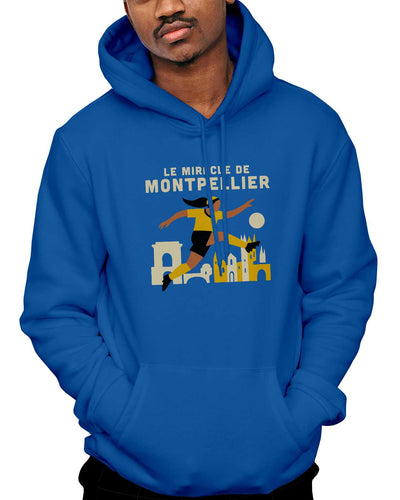
The Miracle of Montpellier
Down 2–0 to Brazil. Written off by everyone. The Matildas roared back to win 3–2 at the 2019 Women's World Cup in one of the greatest comebacks in Australian sporting history. This hoodie is for believers. Printed on demand in Australia.
Shop The Miracle of Montpellier →
The Beautiful Game (Finally)
Nick Hornby once wrote that football is a way of seeing the world — that the shape of the game, its rhythms and reversals, is a kind of grammar we use to understand everything else. For most of its history in Australia, football was a language only some people got to speak. The round-ball game was for migrants, for outsiders, for women who had to sew their own badges onto their kits because nobody was going to do it for them.
The 2023 Women's World Cup didn't just add new speakers to that language. It rewrote what the language was capable of expressing. It expressed inclusion, ambition, and disappointment nobly borne. It expressed the sight of a country looking at itself and finding something it hadn't quite known was there.
But here's what we keep coming back to at Strip Tees: none of it — not the 11 million viewers, not the government's $200 million pledge, not Maya kicking a ball before school — happens without the women who did it when nobody was watching. Pat O'Connor organising the first national championship in 1974. Julie Dolan walking the streets posting flyers in 1979. The First Matildas boarding a plane to Hong Kong in 1975 to play for a country that hadn't yet decided whether it cared about them.
They told us so. Long before anyone was listening — they told us so.
Sources & References
Olympics.com — Reflections on the impact of the Matildas' World Cup heroics (2023)
A-Leagues — Matildas semi-final smashes TV ratings records (August 2023)
Change Our Game / Victorian Government — The Matildas Effect report (December 2024)
Football Australia — Official post-tournament report (August 2023)
The Australian Women's Weekly — How the Matildas have changed women's sport (2023)
Soccer & Society — Game changers? The Matildas and the 2023 Women's World Cup (2025)
Journal of Physical Activity and Health — The "Matildas Effect" (2023)
ESPN — Sam Kerr's goal lives forever (August 2023)
Johnny Warren, Sheilas, Wogs and Poofters (2002) — on football's long road in Australia
Nick Hornby, Fever Pitch (1992) — on what football does to people who love it
0 comments