

Every four years, the host nation of the FIFA Men's World Cup gets to tell the world who it is — not in words, but in a single logo. From Uruguay's Art Deco goalkeeper in 1930 to the template-driven "26" of 2026, we've analysed every World Cup logo for what it reveals about its country's design culture, national identity, and sense of self. Some pulled it off brilliantly. Some had no right being near a Pantone book.
A logo, at its best, is a country's opening argument. It's the handshake at the door before anyone's kicked a ball. And for a month, it appears on everything — tickets, hoardings, television graphics, the back of your mate's badly ironed t-shirt. It has to work as a stamp, a flag, a feeling. It has to avoid clichés while still being instantly recognisable. It has to be honest about a country without embarrassing it. It's probably the hardest design brief in sport. So let's see who pulled it off — and who had no right being near a Pantone book.
Era One: Posters, Not Logos
1930 — 1950 · Before logo design as we know it existed

The first World Cup didn't have a logo. It had a poster — and honestly, that was the right call. Uruguay commissioned local artist Guillermo Laborde, and what he delivered was soaring Art Deco confidence: a goalkeeper caught at full stretch at the peak of the goal frame, arms wide, the ball clamped in his hands, dressed in Uruguay's national colours. The typography sits at the bottom, decorative in the Deco manner, almost secondary to the drama above.
What's remarkable is how un-stereotyped this is. Uruguay didn't reach for gaucho imagery, rolling pampas, or beef cattle. They put a goalkeeper on a football poster. Which, when you think about it, is exactly right: Uruguay had just won back-to-back Olympic gold medals in the sport. They were the best team in the world and they wanted you to know it. The image says: come and take this ball from us. We dare you. It's a national identity built on football, not geography — and that's a rare thing.

The 1934 poster is technically accomplished — a muscular Italian player in tricolour socks dominates the frame, flags of participating nations arranged behind him, the script written in Italian: this is our house, speak our language. It echoes the aesthetics of Roman imperial sculpture and looks, in retrospect, uncomfortably like propaganda — because it was. Mussolini used the tournament to promote fascism, pressuring referees and crowning Italy champions in a tournament that left a very sour taste.
The player's stance — chest out, fists at sides — communicates not celebration but threat. The Deco craftsmanship is genuine but the intent is not sport; it's power. Good craftwork, bad politics. The World Cup poster as state propaganda.

Henri Desme's French tricolore-tinged poster shows a dominant figure with his foot resting on a ball resting on the globe. The visual language — triumph, world domination, a standing figure — is bold and expressive in a very continental European 1930s manner. Three months after Austria was annexed, France hosted the world. The poster has an undeniable gravitas, a dark blue sky that says something important is happening here.
The heavy typography and gestural figure give it an urgency that, knowing what came a year later, feels less like sporting excitement and more like an ominous farewell to a normal world. Technically accomplished. Historically bittersweet.

The last of the poster era and arguably its greatest achievement. Brazil's emblem shows a footballer's boot kicking a ball — but the sock on that foot is made up of the flags of every participating nation, layered together into one piece of fabric. It's a simple idea that contains an enormous idea: every country on earth is part of this moment. The tournament belongs to everyone who qualified.
This is the kind of design thinking that makes you put your coffee down and stare. It communicates inclusion, internationalism, and football's unique capacity to unite, all without a single word of copy. Warm rather than imperial, playful rather than pompous. Very Brazilian in its lightness of touch. That the tournament ended with the Maracanãzo — Uruguay defeating Brazil in front of 200,000 stunned fans in the decisive match — gives the logo a bittersweet historical quality that only adds to its significance.
Era Two: The Modernist Experiments
1954 — 1966 · Host countries design their own identity

Switzerland 1954 produced the first genuine logo of the World Cup — not a poster, not an illustration, but a proper graphic mark. A stylised football overlaid with the Swiss cross, rendered with a simplicity and clarity that was decades ahead of its time. The stitching lines on the ball could equally read as the lines of a football pitch. It's modest, economical — very Swiss — and in its restraint it says something genuine about the host nation: we are a country of precision, order, and quiet quality.
The Swiss design tradition would go on to produce some of the most influential graphic work of the 20th century — Helvetica, International Typographic Style, Emil Ruder. This 1954 logo anticipates all of that: confident in simplicity, trusting the viewer to do some work. It was way ahead of its time.

Attributed to the legendary American graphic designer Saul Bass — the man behind the Hitchcock title sequences, the AT&T logo, the Vertigo poster — Sweden 1958 brings genuine art-world credibility to the World Cup brand for the first time. The mark uses strong simplified silhouettes and dynamic motion: a player mid-kick rendered in flat graphic language, the Swedish blue and yellow grounding it. The "VM" inscription (Världsmästerskapet — World Championship in Swedish) anchors the nationality without over-explaining.
If it is Bass — and the composition, the arrested movement, the tension between figure and negative space all argue strongly that it is — this is the most pedigreed World Cup logo ever produced. It has the feel of a film poster for a very exciting movie. Which, as it turned out, it was: this was the tournament where a seventeen-year-old Pelé announced himself to the world.

Chile 1962 is doing something pleasingly ambitious: it places the Chilean flag inside a shape that reads simultaneously as a football stadium viewed from above and a globe. The upper half, striated like stadium seating; the lower half, a solid hemisphere like the Earth below the horizon. It's a piece of conceptual wit that prefigures more sophisticated ideas about the relationship between the local (this stadium, this country) and the global (the world is watching).
The execution is a little rough — but context matters enormously here. Chile had suffered a 9.5-magnitude earthquake just thirteen months before the tournament, the most powerful ever recorded. The country rebuilt itself and hosted the World Cup anyway. The logo carries some of that defiance: a flag planted in the ground, a stadium rising from it, a globe surrounding both. Chile saying: we are still here.

England 1966 is historically significant as the first World Cup logo to feature the Jules Rimet Trophy — a design decision that would echo through the next six decades. The mark shows the globe superimposed on a football, trophy front and centre, Three Lions badge included, all framed by the Union Flag. It is, to put it diplomatically, crowded. It looks like someone was given a checklist of "things that must be included" and ticked every box simultaneously.
The British tendency to design by committee is on full display. There's no hierarchy, no breathing room, no single clear message. It says everything and therefore says nothing. Compare this to what Switzerland did twelve years earlier — one cross, one ball, total confidence — and you understand the gap between designing for committees and designing for impact. And yet — the mascot, World Cup Willie, that friendly little lion in a Union Flag shirt, is one of the all-time great mascots. The mascot was the identity. The logo was just a form that needed filling in.
Era Three: FIFA Takes Control
1970 — 1998 · The golden age of World Cup design

This is the one. The benchmark against which everything else must be measured. Mexico 1970 is as close to a perfect sports logo as has ever been produced, and the extraordinary thing is how much it achieves with how little. A football rendered in bold positive and negative space — the black pentagons of a Telstar-style ball implied rather than drawn. Below it, the wordmark: MEXICO 70, in a bespoke inline typeface that owes a debt to Lance Wyman's astonishing 1968 Olympic identity (also Mexico, also genius) but transforms that language into something completely new.
The typeface is the thing. Those inline letters — hollow, geometric, stacked with total confidence — are the visual equivalent of a great guitar riff. You hear it once and it's in your head forever. They feel simultaneously pre-Columbian and space-age: a country saying "we have ancient culture AND we are the future." Not many logos manage to hold both ideas without one crushing the other. This one nails it.
Crucially, it avoids every lazy Mexican cliché available to it. No sombreros. No Aztec sun wheels deployed without thought. No lurid folkloric colour explosion. The palette is essentially two colours — bold cobalt and white — and the restraint is precisely what makes it powerful. The richness is in the geometry, not the decoration.


West Germany 1974 went in exactly the opposite direction from Mexico — and mostly made it work. Stark geometric abstraction: concentric arcs of motion in single green, and those two letters "WM" (Weltmeisterschaft — World Cup in German) that reward the viewer curious enough to ask why. Nothing announces Germany as host except the language of the abbreviation. No flag, no national imagery, no sentimental gesture.
What there is is movement — those sweeping lines communicate velocity and rotation, a ball in flight, a world spinning. Very early-70s in its kinetic graphic sensibility, influenced by Op Art, confident in pure abstraction's power. The logo as demonstration of restraint as cultural value — very German. The weakness is that it could be almost any country. The visual language is international, not specifically German. But perhaps that was the point: Germany was hosting the world, and the world needed no instruction on where it was going.

Argentina 1978 is visually beautiful and morally complicated. The logo shows a Telstar-style ball cradled within two sweeping arcs of light blue and white — Argentina's national colours — reading simultaneously as cupped hands, a crowd's raised arms, and an abstract stadium bowl. The composition is warm and welcoming, a visual embrace. It also resembles the new FIFA trophy introduced the previous tournament, as if the logo is already dreaming of possession.
As graphic work it belongs in the same conversation as Mexico '70. Those arcs are elegant, the negative space handled with sophistication, the two-colour restriction giving it enormous clarity. But Argentina in 1978 was governed by a murderous military junta. The generals used the tournament for propaganda, matches were manipulated, and people were disappearing into detention centres while the world watched football. The warm, open arms of this logo were a lie the regime told about itself. It's the most troubling gap between visual language and political reality in this entire history.

España 82 is competent, legible, and entirely uninspired. A football and a Spanish flag, positioned together, with "ESPAÑA 82" written in what can only be described as the font of a regional athletics meet. It does what it says on the tin. The Spanish flag is there. The ball is there. You are left in no doubt that Spain is hosting a football tournament in 1982.
But Spain — a country that gave the world Gaudí, Miró, Picasso, Torres García, an entire vernacular of exuberant visual language — chose to represent itself with two shapes arranged next to each other. It's the design equivalent of responding to "tell me about yourself" with "I like sport and I live in a house." True, technically. But almost heroically unambitious. The acute accent on the N in ESPAÑA is doing more expressive work than anything else in the composition, and that's quite something.

Mexico hosted again after Colombia withdrew, and the design challenge was enormous: how do you follow Mexico '70? The answer was to lean into Aztec visual culture more explicitly — the logo features angular patterning influenced by pre-Columbian geometry, the ball now decorated with cultural motifs rather than rendered in pure negative space, a warmer palette of red and earth tones replacing the electric cobalt blue.
It's not bad. There's genuine effort to encode Mexican identity into the form rather than just flag-drop it. But where Mexico '70 felt discovered, Mexico '86 feels designed — and there's a difference. The original felt effortless. This one shows its workings. The difficult second album problem: everyone's waiting for you to be as good as the first record, and the pressure of that expectation leaks into every decision. Also: Maradona.

Italy 1990 is where World Cup visual identity grew into something properly sophisticated. The logo uses the Italian tricolore — red, green and black — to render a football in three dimensions, the segments structured with stencil typography creating implied depth and real visual texture. For 1990 it felt startlingly modern; it reads now as the era's confident peak.
The Italian design philosophy — fare una bella figura, "make a good impression, always" — is embedded in every decision. The restraint in colour (just those three tones, no more), the geometric rigour of the stencil type, the way the ball seems to exist in real space rather than flat graphic space. Italy said: we are a country that understands beauty as a serious discipline. And they were right not to reach for the obvious — no Colosseum, no Leaning Tower, no David. Just a football, handled with such formal intelligence that Italy's identity is encoded in the how, not the what. The tournament was famously dour — 2.2 goals per game, a record low — but the logo outlived the football.
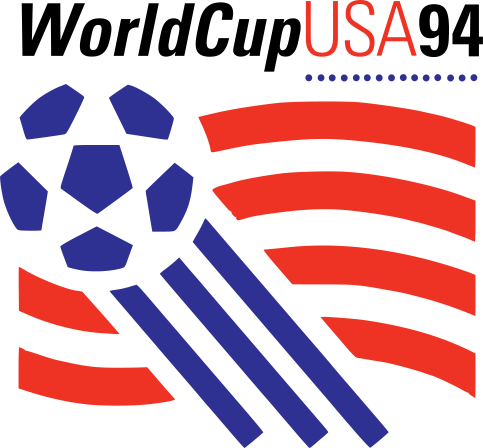
Pentagram — one of the most respected design partnerships in the world — got the brief, and what they produced is deceptively clever. A blue football, kicked diagonally upward, bursts through the red and white stripes of the American flag, those stripes rippling with movement and energy. Simple. Bold. Instantly communicative.
The genius is in the ball's placement. It punches through the flag, disrupting the stripes, as if football itself is arriving in America and rearranging the furniture. It's a perfect metaphor for 1994: the game was new to this country (or at least newly serious), and its arrival was going to change things. The diagonal energy communicates optimism and momentum without sentimentality. The typography — multiple weights, italic and upright mixed, colour inconsistency — is the weak link; it looks like it went through one committee revision too many. But the mark itself is genuinely inspired.

France 1998 is the other serious contender for the greatest World Cup logo of all time. The design principle at its heart is elemental: a football rising above the Earth's horizon, as if it is the sun. Rendered in the blue and red of the French tricolore, the image carries almost philosophical weight — here is the world, and above it, football. This is what we put first.
The composition has real grandeur. The globe's curve is rendered with restraint — just enough to read as "planet Earth" without being literal. The ball rises with genuine dynamism; there's a sense of dawn, of something beginning, of possibility. And crucially, France chose not to show an Eiffel Tower, a beret, a baguette, any of the tourist-brochure shorthand. France has an extraordinary design heritage — from Cassandre to Jean Carlu — and this logo understands that heritage without quoting it directly. It finds its own register. The wordmark "FRANCE 98" is also excellent: clean, confident sans-serif, perfectly sized and placed. Nothing surplus. Very French.
Era Four: The Trophy Takes Over
2002 — 2022 · The FIFA trophy becomes a permanent design element

The first co-hosted World Cup, and the first outside Europe or the Americas, needed a logo that could carry two nations without either one dominating. What was produced is genuinely remarkable: a stylised trophy that reads simultaneously as an abstract figure raising its arms in celebration, as a calligraphic brushstroke from the visual traditions of both host nations, and as the connective tissue between two cultures meeting at their football moment.
The infinity sign woven into the base, representing the twin zeros of 2002, is exactly the kind of lateral thinking that elevates a logo from competent to inspired. The colours span both flags without favouring either. The asymmetry of the composition, the organic sweep of those lines, the deliberate departure from Western logo conventions toward something that feels genuinely East Asian in its gestural quality: all of this is exceptional work. This logo was built according to the artistic traditions and principles of both countries — harmony, asymmetry and dynamism — and it shows in every curve.

Germany 2006 made an interesting and brave choice: the logo is about human connection. The trophy is rendered in a stylised way that contains within it two smiling faces, the "06" numerals forming eyes and expressions, the whole composition generating warmth and openness. The slogan — "A Time to Make Friends" — is a direct, almost disarmingly guileless statement from a country that understood it still carried historical baggage in the global imagination.
The problem is that a logo needs to work in isolation, without the slogan doing the emotional heavy lifting. Without "A Time to Make Friends" as explanation, the smiling faces read as slightly naïve. And Germany is not a country that lacks sophisticated visual identity: Bauhaus, Braun, DIN typefaces — the whole tradition of 20th-century German functionalism was available to be drawn from. They chose a smile instead. Respectable. Slightly undercooked. The tournament itself, however, was wonderful — one of the great atmospheres in World Cup history. The logo tried; the country delivered.

"Ke Nako" — It's Time. The slogan is better than the logo, and the logo is very good. Gaby de Abreu's mark shows a silhouette performing a bicycle kick on a football, surrounded by swooping arcs of red, yellow, blue and green that simultaneously form the shape of the African continent, reference the South African flag, and create the impression of pure joyful energy radiating outward.
The bicycle kick is a bold choice — not a static player but one mid-air, in the most physically spectacular moment in the sport. There's jubilation in the image, a sense of release. And this was the right message: Africa had been denied the World Cup for 80 years. De Abreu spent six months on the design and beat out 25 shortlisted agencies. He understood that restraint was not the right mode for this moment. Africa doesn't need to whisper. Whispers don't contain a continent's worth of anticipation. The Vuvuzela. Shakira's Waka Waka. Iker Casillas lifting the trophy. Spain's first. The logo holds all of that.

Brazil 2014 was the first World Cup logo designed with kinetics in mind — built to move, to animate, to function across screens, hoardings and merchandise simultaneously. The mark shows the trophy formed by three overlapping hands, rendered in the yellow-green of the Brazilian flag, suggesting both the trophy shape and a gesture of welcome, of celebration, of offering.
It's a warm idea and technically accomplished. The hands-as-trophy concept is one of those strokes of lateral thinking that makes you say "why hasn't someone done this before?" And yet something feels slightly corporate about the execution — too polished, too rounded, as if it went through committee approval until every rough edge was smoothed away. The Brazil of Pelé and Garrincha and Ronaldinho has rough edges. They're part of the beauty. The tournament ended with the 7-1 — the Mineirazo, Germany dismantling the host nation in the semi-final. The hands now look like they're reaching for something that got away.

Russia 2018 went deep into its own cultural cupboard and came out with something genuinely distinctive. The mark draws on Khokhloma — Russia's centuries-old folk art tradition of lacquerware, characterised by red, gold and black patterns of extraordinary intricacy. The logo frames the trophy in these flowing ornamental forms: vines, tendrils, organic flourishes that reference onion domes, illuminated manuscripts, the visual language of a civilisation producing extraordinary decorative art for a thousand years.
This is a logo that tells you something real about Russia that the stereotypes don't. Not vodka, not Red Square, not Cold War concrete. Russia's folk art tradition is one of the most beautiful on earth, and placing it in the context of the World Cup says: this is who we are when we're not being a geopolitical argument. We are a culture of extraordinary richness. Come and see. The deep crimson and gold palette is bold without being aggressive, warm rather than imperial.


Qatar's logo is doing a lot, and doing most of it well. The mark is based on the tawes — the infinity symbol — rendered in the maroon and white of Qatar's national flag, the form drawn from the landscape undulations of sand dunes and the flowing robes of Arabic dress. Within it, the trophy. The overall shape reads as an unbroken loop: football's journey, continuing, unending.
The Arabic calligraphic influence in the flowing curves is genuine and not merely decorative — the designers drew on a rich visual tradition that predates Western graphic design by centuries. There's something intellectually honest about a logo that says: we come from a different visual tradition, and we're bringing it with us. Qatar saying "here is our visual language, and it is also the World Cup's for a month" is a statement of real cultural confidence. The controversy around the tournament — migrant worker deaths, human rights, November scheduling — sits uneasily alongside the logo's looping optimism. But the design itself, judged as design, is sophisticated work. Those maroon curves have genuine beauty.
Era Five: The Template Takes Over
2026 → · FIFA chooses brand architecture over cultural expression

Here we are. The first 48-team World Cup, hosted across three nations, and FIFA's answer to the challenge of representing all that complexity is: a very large "26" with the trophy sitting inside it. White, black, gold. Bold numerals. Trophy in the gap. Done. Created by Toronto agency Public Address — also behind the 2023 Women's World Cup identity — and announced to considerable online scorn in May 2023.
Let's be fair first. FIFA has announced this as the template for all future tournaments — from 2026 onwards, the structure stays and only the date changes, with 16 city-specific adaptations providing local colour variation. As a system decision, this has genuine logic. The World Cup trophy is the most recognisable object in football. Placing it front and centre creates instant recognition and visual continuity. As a system, it's coherent.
But — a system is not a logo. Three extraordinary nations, each with astonishing visual cultures and profound football histories, and collectively they get a number with a trophy in it. Mexico's graphic heritage alone — from Wyman's Olympic identity to the Aztec codices to Diego Rivera's muralism — could have produced something extraordinary. Canada's indigenous visual traditions are among the most distinctive on earth. The US has a history of brilliant sports identity work (Pentagram, 1994). The brief could have been thrilling.
Instead, FIFA made the decision that matters to FIFA: brand consistency over cultural expression. From 2026 onwards, the World Cup belongs to FIFA's mark rather than its host's identity. That's coherent for a commercial entity. It's a disappointing choice for those of us who look at these logos as dispatches from specific places and specific moments in time. The era of the World Cup logo as a cultural document — begun by Laborde in Uruguay in 1930 — is over. We are in the era of the brand template.


What the Best FIFA World Cup Logos Have in Common
Across ninety-six years and twenty-two tournaments, the World Cup logo has gone from handmade art poster to global brand template. And looking at all of them in sequence, a few things become clear.
The best logos — Mexico '70, France '98, Brazil '50, Korea/Japan 2002 — share a quality: they are specific without being parochial, proud without being arrogant. They find something true about the host nation — not the tourist-brochure version, not the cliché shorthand — and express it with real design intelligence. Mexico '70 didn't show you a sombrero. France '98 didn't show you the Eiffel Tower. South Africa 2010 didn't show you a safari. They went looking for something deeper, and they found it.
The worst ones mistake "including our flag" for "expressing our identity." These are not the same thing. A flag is a starting point, not a destination. The best designers understood this and went further. The worst ones stopped at the flag and called it done.
A strong logo, in this context, serves both the inhabitants of a country and its visitors — it should be something the locals are proud of, that says something true about their culture, while also being welcoming and legible to an international audience arriving with no prior knowledge. That dual service is harder than it looks. Uruguay 1930 did it. Italy 1990 did it. Russia 2018 did it. España 1982, not so much.
The 2026 decision to standardise the logo system is understandable from a commercial perspective and regrettable from a cultural one. Each World Cup logo used to be a unique document of its moment — a snapshot of a nation's self-image filtered through the design vocabulary of its era. From now on, they'll be variations on a template. We know where we stand.
Heading to the 2026 World Cup?
Mexico, Canada, or the USA — we've got gear for the road. Football tees printed locally, shipped globally. Just like you, we're football fans first.
Shop Strip Tees →


0 comments